
Grant Sheriff Custody Outcomes
A Grant County Sheriff custody event can end in more than one way. The person may leave a short local hold under lawful release authority. The Sheriff may instead transport the person to a county jail that performs the booking. After sentencing, a person can move into Minnesota Department of Corrections custody. A federal writ or hold can lead to federal custody, while another lawful hold can send the person to another agency. Each result belongs to a different record system.
The release or movement entry must be tied to the agency named in it. A direct release by Grant County ends Grant custody. A transport to a receiving jail does not. Nor does a transfer to Minnesota DOC mean the person returned to the community. Ask for the movement reason and destination, then check the agency that received the person. The court file can explain the legal order, but the physical custodian records when its control began or ended.
Confirm a Grant Sheriff Release
Grant County has no official online jail roster, recent-release feed, or custody archive. Confirmation therefore starts by identifying who held the person. Give the Sheriff a full name, an approximate arrest date, and a court file or other identifier when known. Ask a precise question: which facility held the person, did Grant record a release or transport, and what agency received the person if custody continued?
- Contact the Grant County Sheriff. Ask whether the office has an arrest, temporary custody, or transport record for the named person and date range.
- Write down the exact holding facility. If another county jail booked the person, use that jail’s official custody channel for the physical release record.
- Search the correct person and agency through Minnesota VINELink. Read an out-of-custody event as an agency-specific change, not proof that all custody ended.
- Review the Grant County case through Minnesota Court Records Online. Bond, dismissal, commitment, sentence, or revocation entries may explain the authority for movement.
- Request the custodian’s admission, release, and transfer fields. Ask for the destination or receiving agency when the event was not a direct community release.
If the record points to state prison, use the Minnesota DOC Locator. An Incarcerated status means DOC release has not occurred. Under Supervision as of supports a prison-to-community transition while DOC authority continues. The Locator does not verify a jail-only case. The broader Grant County released inmates search and records path explains how to switch between local, state, court, VINE, and federal sources.
Grant Sheriff Release Records
The Sheriff identifies central-records keeping and prisoner transport among its duties. No dedicated release-record form, request email, fixed fee, or promised response period was found. Call first to learn whether Grant owns the requested data and how the office prefers a written request. Round-the-clock office access supports operational contact, but it does not promise that an older records request will be filled at once.
10 2nd Street NE
Elbow Lake, MN 56531
Phone: 218-685-8280
Fax: 218-685-5319
Official page states 24 hours a day, seven days a week
Direct the request to Grant central records only for records Grant maintains. Ask for public data that identifies the person, booking or event number, arresting agency, admission date and time, release date and time, movement reason, court file number, public hold notation, and receiving agency. If the Sheriff only transported the person, ask for the Grant transport or arrest record and send the physical release request to the jail that booked the person.
Under Minnesota Statutes section 13.03, inspection of public government data is free. Authorized copy costs may apply. For one hundred or fewer black-and-white letter or legal pages, the statutory cap is twenty-five cents per page. Ask for electronic copies and a cost estimate. If material is withheld or redacted, ask the custodian to identify the legal basis.
Grant Sheriff Transport Custody
The official Grant County Sheriff page describes law enforcement, court security, prisoner transport, civil process, enhanced emergency service, and central-records work. It does not identify a jail division, a jail building, a bed count, or an inmate roster. For that reason, the Sheriff’s Office must not be described as a verified “Grant County Jail.” It is the verified local custody-routing and records access point.
The official page also does not publish release times, exit locations, property pickup rules, weekend practices, bond procedures, or a release desk. Those details depend on the facility that actually held the person. Do not borrow logistics from another Minnesota jail. Once the Sheriff gives the holding facility, contact that custodian for current operational instructions and for its own release or transfer record.
The captured official source shows the precise local role. Review the Sheriff custody and transport page before choosing a jail lookup.
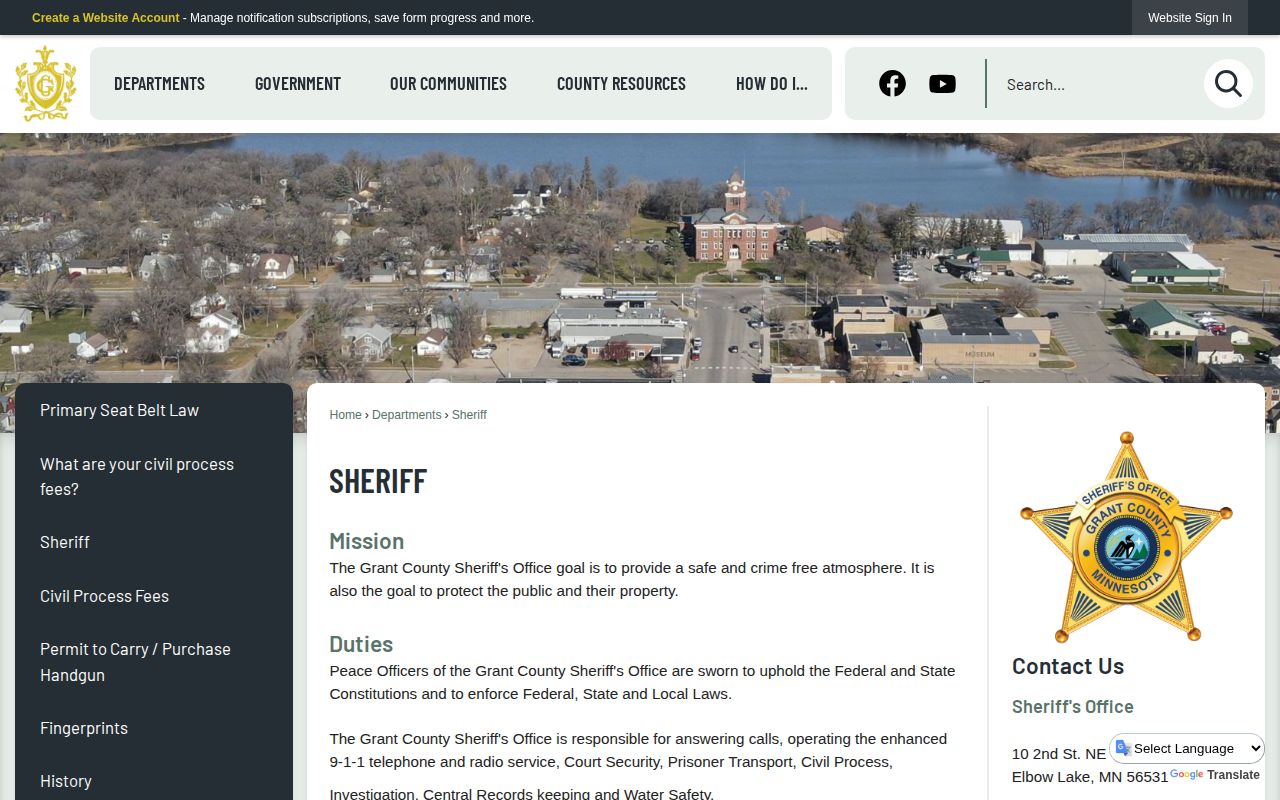
The image documents the office’s prisoner-transport and central-records functions. It does not show an inmate list or establish that a jail operates at the courthouse address.
Grant Custody May Move Elsewhere
The absence of an identified county jail changes how a Grant County arrest should be traced. The arresting agency and booking agency may differ. Grant can maintain the incident, warrant, or transport record while an outside county holds the booking sheet, custody status, booking photograph, and physical release entry. A complete record search may therefore require two agencies, with each asked only for the data it created.
Wilkin County Jail is one documented example, not a default destination. A dated report from June 2026 describes one Grant County arrestee booked there. That single case supports Wilkin as a possible receiving jail, but it does not prove a standing or exclusive arrangement. Confirm the named person’s actual route with Grant Sheriff or the court before using Wilkin’s channel. If Wilkin was the custodian, its own release or transfer record controls when Wilkin custody ended.
Other paths also remain possible. A sentenced person may enter DOC. A federal case may involve the U.S. Marshals Service before Bureau of Prisons designation. Immigration custody requires the ICE locator or agency records. A transfer from Grant ends one agency’s control, while physical custody may continue without a gap.
Note: Match every release claim to the named custodian, event date, movement reason, and next agency when the record supplies one.
Why Grant Release Searches Start Elsewhere
Grant County’s unusual local feature is its transport-centered public record. The official Sheriff description emphasizes prisoner transport and central records, while the county sitemap exposes no jail, roster, release-list, or booking-photo page. That gap is not proof that nobody is held after a Grant arrest. It means the receiving facility must be found before a custody search can be reliable.
Section 19’s facility-history angle is shown by the contrast between the official Sheriff record and the Wilkin case. The Wilkin County Jail page identifies a real jail, while a case-specific 2026 report connects one Grant arrest to that facility. Neither source authorizes a claim that every Grant detainee goes there. This is why facility identification is part of release verification, not a minor preliminary step.
The same care applies to Grant’s warrant channel. The county page sends readers to a regional LETG interface hosted on Stevens County infrastructure. That system concerns active warrants, not jail admissions or releases. A warrant may explain why a person is sought after an earlier release, but it cannot supply the end time or disposition of that earlier custody event.
Read Grant Release Records Carefully
A release record is a custody-movement record. It is not always a single document with that title. Grant County may maintain a transport log, incident entry, warrant record, or temporary custody movement. The receiving jail may maintain a booking sheet and disposition. A court order can explain the legal basis. VINE may show an agency status event. These sources support each other, but they are not interchangeable.
| Record or status | What it establishes | What to check next |
|---|---|---|
| Grant transport record | Grant moved the person to a named destination. | Check the receiving custodian’s admission and later movement. |
| Direct Grant release entry | Grant’s own temporary custody ended. | Read the reason and any hold or destination field. |
| Outside jail release | The named jail ended its booking. | Confirm whether the event was community release or transfer. |
| DOC under supervision | The person left prison but remains under DOC jurisdiction. | Read the effective date, district, agent, and expiration date. |
| Court order | The legal basis for bond, dismissal, sentence, or commitment. | Use the physical custodian for the actual movement time. |
“Bond posted” may come before departure if another hold remains. “Time served” can end a custodial part while probation or other obligations remain. “Transfer” means custody continues elsewhere. Final discharge is different from physical release from prison because DOC supervision can continue after the person leaves a facility. The record’s status label and receiving-agency field matter as much as its date.
Older data may require a direct written request. The Sheriff and county sitemap state no online retention period because no release view was found. Ask whether the requested movement data is still maintained and whether a retention schedule applies. A sealed or expunged case may also change public access. Never fill an official-record gap with an assumption based on a missing web result.