
Grant County Release Date Meaning
A scheduled date and an actual release are not the same event. Minnesota DOC uses a forward-looking field for a person who remains incarcerated. The record still describes custody until the status changes. Physical departure may occur later because staff must process the release, resolve holds, and complete the movement record. For a Grant County case, the agency named on the arrest may not be the agency that has physical custody. The Grant County Sheriff describes prisoner transport and central-records duties, but it does not identify an operating county jail on its official page.
A pretrial detainee has no sentence-based release date. Bond may create a route out, yet posting bond does not clear another warrant, detainer, or commitment. A detainer is a request from another authority to keep custody or arrange transfer. A dismissal or release order removes one legal basis for detention, but the jail must still complete the physical release. A sentenced inmate may have a computed date, though it remains subject to the sentence, credit, conduct, and other lawful orders.
Grant County release questions therefore start with custody identity. Call the Grant County Sheriff and ask which jail admitted the person. If Grant only transported the person, the receiving jail holds the physical release calculation. Wilkin County Jail is documented as a receiving jail in one Grant case, but that does not establish that it receives every Grant detainee.
Find Grant County Release Dates
The Minnesota DOC Locator is the right first tool only for an adult committed to the Commissioner of Corrections who is still under DOC jurisdiction. It is not a county-jail calculator or a permanent archive for every former prisoner. Search by the full six-digit MNDOC Offender ID when available. A name search uses prefixes, so compare identity and court information before relying on a result.
- Ask Grant County Sheriff which facility holds the person and whether the Grant event was custody, transport, or transfer.
- If the person is in state prison, search the complete MNDOC ID or name in the DOC Locator and open the matching record.
- Read Current Status before any date. An incarcerated status means the person has not yet left DOC custody.
- Read Anticipated Release Date and Expiration Date as separate fields. The second is the expected end of DOC jurisdiction.
- Review the linked court file and sentencing order for the executed sentence, jail credit, consecutive terms, and special conditions.
- For a county-jail term, ask the confirmed receiving jail for its current calculation instead of applying a DOC formula.
- After the expected date, confirm a status such as Under Supervision as of or request the movement record.
The official public example shows how Minnesota labels the field. View the DOC record with an Anticipated Release Date before comparing the same labels in a current result.
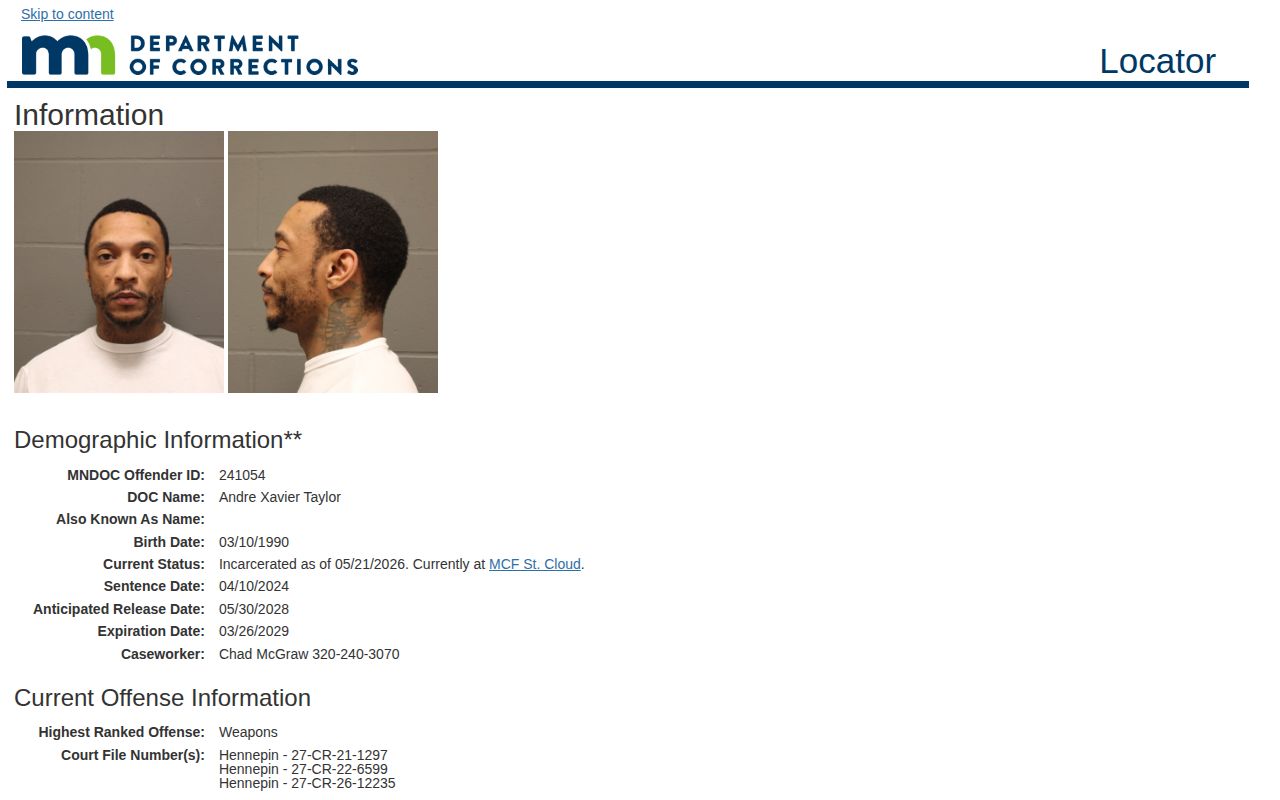
The image helps locate the field, but its person-specific date is not a prediction for anyone else. A fresh commitment can also take several business days to appear.
Note: A county-jail-only detainee generally will not appear in the DOC Locator unless the person was committed to Minnesota DOC.
Grant County State Release Formula
For an ordinary fixed Minnesota felony sentence for an offense on or after August 1, 1993, Minn. Stat. § 244.101 starts with two-thirds of the executed sentence as imprisonment and the remaining one-third as supervised release. Supervised release is the community portion of a prison sentence while DOC jurisdiction continues. It is not final discharge. The court must explain the total term, prison portion, community portion, and the risk that disciplinary confinement can extend time in prison.
This is not an 85-percent rule. The ordinary baseline is about 66⅔ percent in prison and 33⅓ percent on supervised release. A 60-month example would begin with 40 months of imprisonment and 20 months of supervised release. That arithmetic teaches the statutory split; it does not predict an individual's date. Sentence start, jail credit, consecutive sentences, discipline, special release laws, and earned credit require the court and DOC record.
| DOC field | What it means |
|---|---|
| Current Status | Whether the person remains incarcerated, is on a conditional placement, or is under supervision. |
| Anticipated Release Date | DOC's current forward-looking estimate for departure from incarceration. |
| Under Supervision as of | The effective date of transition from prison to community supervision. |
| Expiration Date | The anticipated end of the sentence or DOC jurisdiction, not the prison gate date. |
Conditional labels also need care. Work release or the Challenge Incarceration Program may change placement without creating final discharge. A wanted-fugitive status can reflect an alleged violation during community supervision. None of those labels should be reduced to a simple “out” or “in” answer.
Grant County MRRA Release Credit
The Minnesota Rehabilitation and Reinvestment Act creates earned-incentive release credit for eligible people. Under § 244.43, DOC must maintain a policy through which qualifying participants can earn credit, including through rehabilitative programming. Sections 244.44 and 244.45 govern the calculation and exclusions. The credit enters the prison-term calculation. It does not erase the full supervised-release obligation.
The limit must be stated with both parts. Earned credit can subtract no more than 17 percent of the total executed sentence, and it cannot reduce imprisonment below one-half of that sentence. The maximum is a cap, not an automatic discount. Eligibility, participation, achievement, current policy, and the individual record all matter. Credit may also be withheld or revoked for institutional-rule violations or a criminal act while incarcerated.
The official MRRA overview shows how DOC presents the earned-release framework.
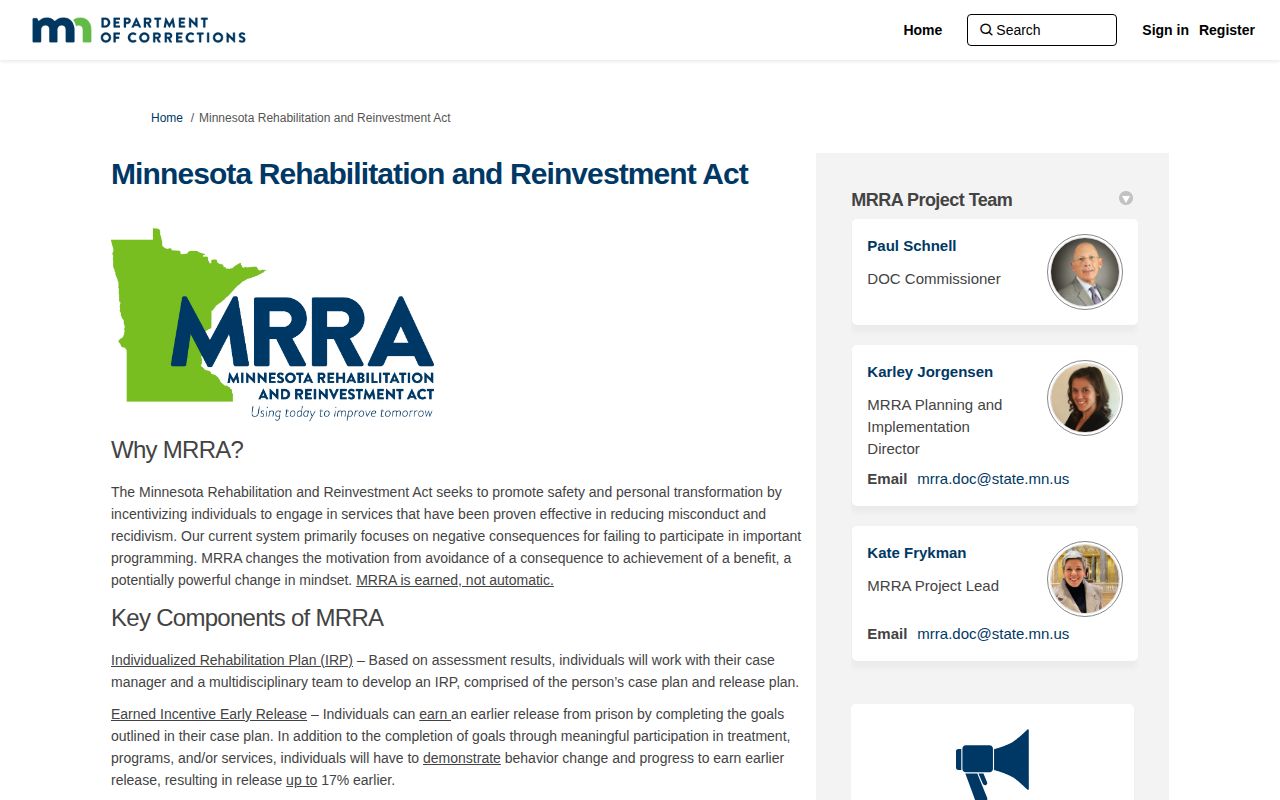
The overview provides the statewide context, while the live DOC record and current policy control an eligible person's calculation. Life sentences, qualifying old indeterminate sentences, and people governed by old-law good time are among the statutory exclusions.
Grant County Old-Law Release Dates
Older Minnesota records can use a different good-time structure. Minn. Stat. § 244.04 applies principally to offenses committed before August 1, 1993. Its qualifying fixed-sentence rule gives one day of reduction for each two discipline-free days, with that time accruing to supervised release. It is not the standard formula for a modern Grant County felony.
Do not combine old-law good time with MRRA credit. The offense date, sentence type, and DOC record determine which framework applies. Life and indeterminate sentences may also fall within the limited jurisdiction of Minnesota's Supervised Release Board rather than an ordinary fixed-date calculation. Parole, in this setting, means discretionary release under an older or special sentence, while modern supervised release is generally the set community portion of a determinate term.
Note: The offense date and sentence type matter more than the date someone asks for the Grant County release calculation.
Why Grant County Release Dates Move
An Anticipated Release Date is administrative and forward-looking. It can move when DOC receives new legal information or recalculates time. Some changes make the date earlier; others extend confinement. The public field alone may not explain the adjustment, so compare the court file, sentence record, current policy, and facility response.
| Factor | Possible effect on the release date |
|---|---|
| Disciplinary confinement | Can extend actual imprisonment, potentially through the executed term under § 244.101. |
| MRRA credit | Earned credit may advance the date; withheld or revoked credit may move it later. |
| Jail credit or court correction | A corrected credit award, sentence, or court order can change the remaining prison time. |
| Multiple or consecutive sentences | One term may follow another and change the simple date a single case suggests. |
| Conditional-release law | An offense-specific term can alter the ordinary two-thirds and one-third path. |
| Revocation or new sentence | A return to prison or added term requires a new calculation. |
| Work release or CIP | A conditional placement can change the displayed status or path without creating final discharge. |
| Life or indeterminate review | A board process and statutory eligibility may replace a routine fixed-date path. |
| Other agency hold | A detainer may change the destination or prevent community release even when the DOC date arrives. |
A hold or detainer can also affect the physical outcome even when the DOC date does not change. The person may leave one facility and enter another agency's custody. “Released from DOC” is not the same as returned to the community unless the receiving status supports that conclusion.
Grant County Jail Release Dates
The DOC date field may never apply to an ordinary local jail sentence. Grant County's official web inventory offers no jail roster, release-date calculator, or published good-time rule. The Sheriff may have the arrest or transport record, but the jail that physically housed the person is the best source for the jail calculation. Confirm that facility before asking for a date.
Local jail time depends on the actual sentence order, credited days, the receiving jail's calculation, other holds, and controlling law or policy. No Grant-specific jail good-time or weekend-release rule was found in the research. It would be wrong to apply the state-prison two-thirds formula. Use Minnesota Court Records Online to review the Grant criminal case and sentencing entries, then ask the jail to explain its current release computation.
Wilkin County Jail is one documented receiving facility, not an automatic answer for all Grant cases. A release from Wilkin could mean return to the community, transfer back to Grant, commitment to DOC, or movement to another authority. Each event ends only the named custodian's control.
Confirm Grant County Release Dates
For a state prisoner, DOC directs detailed release-date questions to the correctional facility or central records. Minnesota DOC lists 1450 Energy Park Drive, Suite 200, Saint Paul, MN 55108, phone 651-361-7200, fax 651-642-0223, and co-records.doc@state.mn.us. Ask for the current calculation and identify the MNDOC ID, displayed date, and court file. Historical records are also the fallback after final discharge removes a person from the live Locator.
When the date nears, a person-specific alert can supplement direct confirmation. The VINELink Release Check explains how to search and register for a custody-change notice. VINE may lag and reports the feeding agency's event, so it is not a certified movement record. The facility remains the source for same-day departure.
Read every date in context. Current Status shows whether custody continues. Anticipated Release Date estimates a future prison movement. Under Supervision as of supports the later transition, while Expiration Date concerns the end of jurisdiction. The Grant County released-inmate search and records path covers the broader task of locating a person after custody changes. A precise date answer comes from the correct custodian, the sentence record, and the latest status together.