
Grant County Release Meaning
A release record marks a change in one custodian’s legal or physical control. It is not a judgment about the person. In Grant County, that distinction is vital because the Grant County Sheriff’s Office describes prisoner transport and central-records duties but does not identify an operating county jail. A person arrested by a Grant deputy may be released from a brief hold, booked at a receiving jail, transferred after sentencing, or delivered to another authority. Each event belongs to the agency that performed it.
The phrase “Grant County released inmate” can therefore describe several paths. A person may return to the community after bond, a court order, dismissal, or completion of local custody. Another person may leave a county jail for Minnesota Department of Corrections custody. A federal writ or immigration detainer can produce another transfer. Prison release to supervision ends confinement but not DOC jurisdiction. Final discharge comes later. The most reliable record names the releasing agency, the event time, the disposition, and any receiving agency.
Grant County Release Types
The status label determines what should be checked next. Bond may satisfy one case while another hold keeps the person confined. A court dismissal may remove the legal basis for detention, yet the jail still records the time when processing ended. “Time served” concerns the custodial part of a sentence and does not by itself resolve supervision, fees, or another case. Transfer means continued custody elsewhere.
| Release or movement | Meaning | Next record |
|---|---|---|
| Bond or court-order release | The agency may release after conditions and all holds clear. | Movement record plus the Grant court case |
| Time served or sentence complete | The local custodial term was credited or completed. | Jail calculation and sentencing entry |
| Probation | Court-ordered community supervision, sometimes without prison. | Court file and the correct probation office |
| Supervised release | The community part of an executed Minnesota prison sentence. | DOC Locator status, district, agent, and expiration |
| Transfer | Grant or a jail ended custody because another agency accepted it. | Receiving jail, DOC, BOP, ICE, or USMS channel |
| Final discharge | The sentence or supervision jurisdiction ended. | DOC history or a court discharge order |
Other terms also need care. A detainer is a request or authority from another agency that can block community release. Work release and Challenge Incarceration Program release are conditional placements. Escape or fugitive status is not a lawful release. Death ends custody for a reason that must be stated plainly, never folded into ordinary release language.
Grant County Release Record Fields
No public Grant County release form demonstrates a fixed field set. A focused request should ask for fields that are maintained and public without claiming all exist. Identity fields help separate people with similar names. Movement fields show the physical event. Court and receiving-agency fields explain why the event occurred and where custody went next.
| Field to request | What it can establish |
|---|---|
| Full name and identifiers | Which person the record concerns |
| Booking number and admission time | The custody episode and its start |
| Arresting and holding agencies | Who arrested the person and who kept the booking |
| Release date and time | When that agency’s custody ended |
| Disposition or movement reason | Bond, order, completion, transfer, or another maintained label |
| Destination or receiving agency | Whether custody continued elsewhere |
| Hold notation and court file | Other authority and the linked legal case, if public |
| Booking photograph | The identification image maintained by the booking agency |
A release record may be a jail-management entry, booking sheet, transport log, bond record, sentence calculation, DOC status transaction, VINE event, or court order. These documents are related but not interchangeable. The jail or prison movement record best fixes physical departure. The court file explains legal authority. VINE reports a participating agency’s status event. No one source should be stretched beyond its scope.
Can a release date prove return to the community? Not always. A release-to-agency or transfer entry shows the first custodian ended control. Confirm the receiving system before describing the person as back in the community.
Request Grant County Release Records
The Sheriff page gives no dedicated release-record form, request email, fixed charge, or guaranteed response period. Start with central records, but first ask whether Grant held the person or only transported them. If an outside jail created the booking, that jail owns the physical release or transfer entry. Grant may still maintain arrest, warrant, incident, and transport data.
- Call the Grant County Sheriff at 218-685-8280. Give the full name and an approximate arrest date, then ask which facility booked the person.
- Address the written request to the agency that maintains the requested data. Ask Grant for Grant-owned records and the receiving jail for its booking and movement record.
- State a clear date range and list the admission, release, transfer, disposition, receiving-agency, court-file, and photograph fields sought.
- Ask for electronic copies and an itemized cost estimate before charges are incurred. Request the legal basis for any withholding or redaction.
- Use the court or the correct state or federal records route when those agencies own the decisive record.
10 2nd Street NE
Elbow Lake, MN 56531
Phone: 218-685-8280
Fax: 218-685-5319
Office listed as open 24 hours a day, seven days a week
Round-the-clock office availability does not promise immediate archival processing. Under Minnesota Statutes section 13.03, inspection of public government data is free. Authorized copy costs may apply. For one hundred or fewer black-and-white letter or legal pages, the statutory cap is twenty-five cents per page. Copies that cannot be supplied at once must come as soon as reasonably possible, not within a fixed statewide number of days.
Correct Grant County Release Data
A person named in government data has a correction route under Minnesota Statutes section 13.04. The person can seek access to data about themselves and challenge a field that is inaccurate or incomplete. That route matters when a release date, identity, or custody status is wrong.
Identify the exact disputed field. Preserve the record as received, then attach official material that supports the requested change. Contact the responsible authority that created or maintains the data before trying to correct a copy elsewhere. The agency’s response and appeal procedure should control the next step.
Note: A correction request should target the originating government record, not a third-party copy that may have lost context.
Grant County Court Release Trail
Grant County Court Administration keeps local case records in Minnesota’s Eighth Judicial District. A court file can preserve bond conditions, dismissal, a stayed or executed sentence, a warrant of commitment, revocation, probation, and discharge after a short custody event is no longer visible. Search Minnesota Court Records Online by exact case number when possible. A name-only result needs an identity check.
The court entry explains legal authority, not always physical release time. A bond order does not prove payment or clearance of every hold. A dismissal may precede jail processing. A warrant of commitment can explain movement to DOC rather than release to the community. Grant Court Administration can provide clerk-held public documents not available remotely. Court records follow Judicial Branch access rules because section 13.90 excludes the judiciary from Chapter 13. Do not send the court a sheriff-style data request.
Expunged Grant County Release Records
Retention and public access are different questions. No Grant page states how long release data remains online because no county roster or release archive was found. Agency retention schedules govern possession. Minnesota expungement law can later limit public disclosure even if restricted records remain.
Several petition waiting periods in Minnesota Statutes chapter 609A run from discharge of the sentence, not the earlier date when a person left jail. Automatic expungement may also cause a case or agency record that once appeared publicly to disappear. That later change in access does not change the historical release event. Juvenile, sealed, expunged, confidential, and otherwise nonpublic material should not be reconstructed from stale copies.
Find Grant County Released Inmates
A released-first search does not keep refreshing a current roster. Grant County publishes no such roster. The search must identify the custodian, verify the agency event, read the legal disposition, and follow any transfer. A Grant County last-24-hours inquiry begins with the same source-based fallback because no official daily feed exists.
- Ask Grant Sheriff which jail booked or received the person and whether Grant’s event was a release or transport.
- Search Minnesota VINE under the correct participating agency. Treat “out of custody” as agency-specific until a transfer is ruled out.
- Review the Grant criminal case in MCRO for bond, dismissal, sentence, commitment, revocation, or discharge.
- Request the booking and movement record from the actual jail or Grant central records, based on ownership.
- Use the Minnesota DOC Locator for a person committed to the Commissioner, not for a jail-only case.
- Switch to BOP, ICE, the federal docket, or USMS records when federal or immigration authority applies.
- For old events, rely on agency records and court files. Live locators are not permanent archives.
Compare middle names, birth details when lawfully shown, booking or offender identifiers, court numbers, agency, and case context. A VINE no-result may reflect spelling, timing, coverage, or a different jail. A fully discharged former state prisoner may no longer appear in the live DOC tool. Search results must match both person and custodian.
Minnesota DOC Release Search
The Minnesota DOC Locator covers adults committed to the Commissioner who remain under DOC jurisdiction, whether incarcerated or released to supervision. It is not a list of all people once booked in Grant County. Search first and last name with the tool’s prefix behavior, or use the full six-digit MNDOC Offender ID. New commitments can take several business days to appear.
| Locator field | How to read it |
|---|---|
| Current Status | Incarcerated, under supervision, conditional placement, or another current DOC status |
| Anticipated Release Date | A forward-looking date for an incarcerated person, not proof of departure |
| Under Supervision as of | Status-effective date supporting release from prison to community supervision |
| District and agent | The public supervision route shown for the person |
| Expiration Date | The expected end of DOC jurisdiction, distinct from prison release |
| Court file numbers | Links between the DOC record and sentencing cases |
The official Locator screen shows how Minnesota separates prison and supervision status. Review the Minnesota DOC source before using the displayed fields.
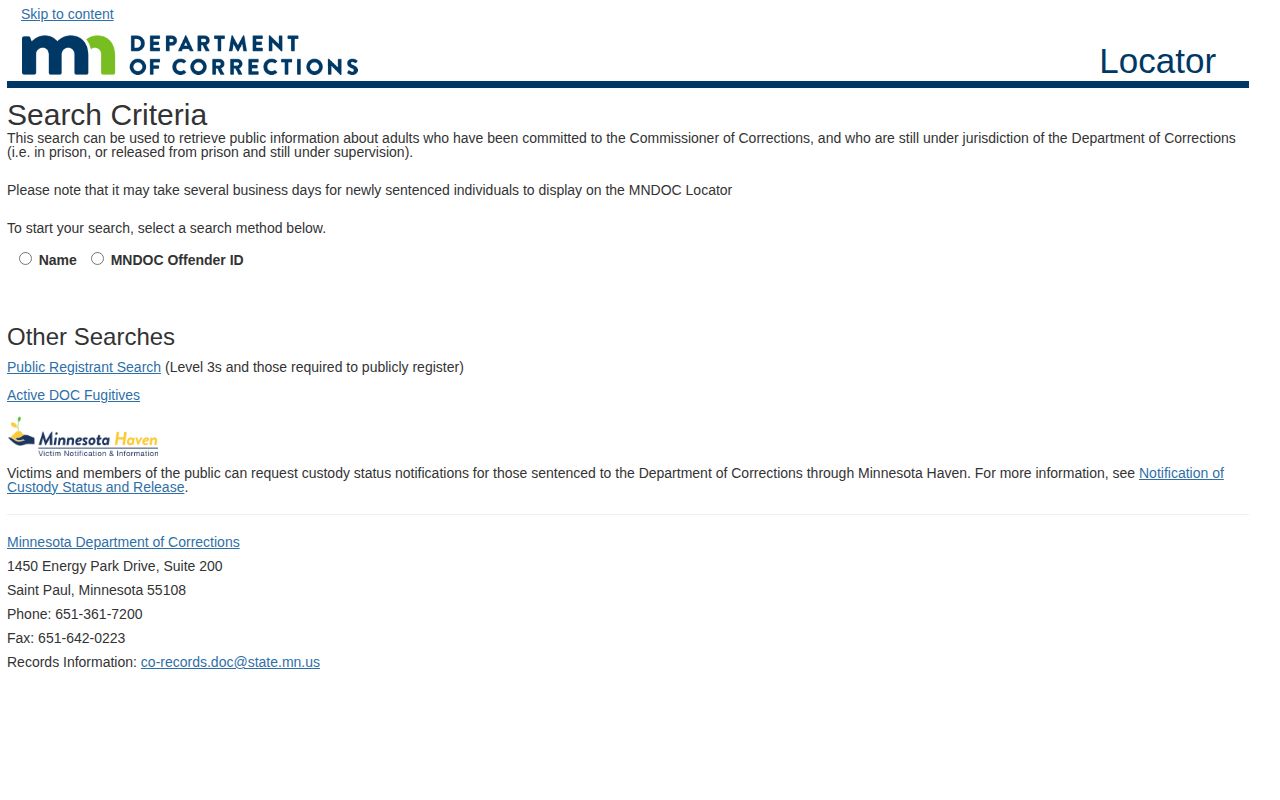
The screen supports a state-prison search, while Grant central records and the receiving jail remain the right channels for a jail-only release.
Grant County Has No Roster
The official Sheriff page and county sitemap expose no current jail roster, recent-release feed, 24-hour view, 72-hour view, booking-photo gallery, or sheriff mobile app. There is no honest feed URL, field list, update cycle, retention period, or photo flag to publish. A date-bounded records request can seek existing public release or movement data, but an office may not have to create a new report that does not exist.
For a recent event, call Grant Sheriff to identify the actual holding jail. Search the person in VINE under that agency, check the court case, and request the movement record from its custodian. Do not combine snapshots of unrelated current rosters and call the result a Grant County release list. Transfers, data lag, name variations, and custody in another facility make that method unsound.
Grant County Custody Routes
Grant Sheriff’s official duties center on law enforcement, prisoner transport, and central records, not a named jail division. A June 2026 report documents one Grant County arrestee being booked at Wilkin County Jail. That case proves an outside receiving path can occur. It does not establish that Wilkin houses every Grant detainee or holds an exclusive contract.
Confirm each case with Grant Sheriff or the court. If Wilkin held the person, Wilkin owns its booking and physical movement record. Grant may own the arrest or transport record. If a sentence sent the person to state prison, DOC becomes the custody source. Federal and immigration paths move to their own systems. Agency labels matter more than the county named in the original arrest.
Grant County Release Ride Options
Rainbow Rider’s Grant County service is the documented local public transportation option. It serves Grant and neighboring counties and describes weekday service involving Hoffman, Elbow Lake, and Alexandria. Dispatch is 1-800-450-7770.
Rainbow Rider is not a correctional release shuttle. No source says that it enters jail property or waits for a person being processed out. Call ahead about routes, reservation rules, access needs, the nearest lawful stop, and timing. First identify the actual holding facility, which may be outside Grant County. Release processing can change, so transportation should not be scheduled from an estimated time alone.
Grant County Release Supervision
Probation and supervised release are not synonyms. Probation follows a court order and may occur without state prison. Supervised release is usually the community portion of an executed Minnesota prison sentence. Parole applies to limited life, old-law indeterminate, and qualifying youth-offense cases reviewed by Minnesota’s Supervised Release Board.
- Probation
- Court-ordered supervision in the community.
- Supervised release
- The community portion of an executed prison sentence while DOC jurisdiction continues.
- Parole
- Conditional release used for limited eligible sentence groups under board review.
- Absconder
- A supervised person alleged to have stopped reporting or evaded supervision.
- Discharge
- The end of sentence or supervision jurisdiction, often later than physical release.
Grant adult felony field service is regional. DOC routes the county through Morris in the Moorhead District. The person’s Locator record may show the district and agent. A local probation case may instead require the court and regional probation provider. Grant County parole and probation records must therefore be checked through the route shown by the case, not a presumed local office.
Grant County Release Notifications
Minnesota VINELink can show a person-specific custody event from a participating county or state correctional agency and accept registrations for offered alerts. Choose the correct person and agency, compare identifiers, then read the status and event date. Phone, text, email, or in-app methods may be offered by the workflow.
“Released” or “out of custody” means the feeding agency no longer reports custody. It may still be a transfer. VINE can lag and is not the certified movement record. A no-result can reflect spelling, agency selection, coverage, timing, or a historical event. Keep an alert active when useful, but confirm the event with the facility.
Note: VINE support is available at 1-866-277-7477, while the originating agency remains the source for certified movement details.
Grant County Federal Release Checks
The BOP Inmate Locator covers federal inmates from 1982 forward. A result may show “Released” or “Not in BOP Custody,” a federal release date, and identifying fields. That status ends BOP custody only. Another correctional agency may still hold the person. BOP FOIA is the historical movement-record route after the locator is checked.
ICE’s online locator uses an A-number and country of birth or biographical search fields. A no-result does not prove release. Recent intake, transfer, spelling, identifiers, and coverage can affect it. ICE FOIA can address history. Federal pretrial movement may belong to USMS and the federal docket rather than BOP. A Grant jail transfer to ICE should be described as the end of county custody and the start of immigration custody when the records support both events.
Grant County Release Search Comparison
Each source answers one part of the custody story. The wrong source can turn a true fact into a false conclusion. Match the person’s legal and physical custodian to the system below.
| Source | Best use | What it cannot prove alone |
|---|---|---|
| Grant Sheriff central records | Grant arrest, transport, and Grant-owned movement data | A receiving jail’s later release |
| Receiving jail record | Booking and release or transfer from that jail | Freedom after transfer |
| MCRO and court clerk | Bond, dismissal, sentence, commitment, revocation, discharge | Exact physical departure time |
| Minnesota DOC Locator | Current prison or active supervision status | A jail-only Grant case or permanent discharge archive |
| VINE | Participating-agency status event and future alert | Certified reason for movement |
| BOP, ICE, or USMS | The matching federal custody channel | Another agency’s present custody |
Move from one system to the next only when the record supports that move. A county transfer entry should lead to the named receiving agency, while a court commitment to Minnesota corrections should lead to the DOC Locator and DOC records.
Grant County Release Facilities
The facility map contains only sources supported by official or case-specific evidence. No state prison, federal prison, ICE detention center, or municipal jail was established within Grant County. State and federal locators still apply when a Grant case moves into those systems, but they are not local buildings.
The first local routing and central-records source, with no verified operating jail or online roster.
A documented, nonexclusive receiving jail that must be confirmed for the named person and date.
The confirmed holding agency supplies the physical release record. Grant Sheriff can route the inquiry, while VINE and the court can corroborate the custody event and its legal basis.