
Grant County Supervision Terms
“Parole” and “probation” are often used as if they mean the same thing. Minnesota records require more care. Probation usually comes from a court order and may follow a local jail term, a stayed sentence, or no prison term at all. Supervised release is the community part of an executed Minnesota prison sentence. A person can be physically out of prison and still remain under Minnesota Department of Corrections jurisdiction. Parole applies mainly to a narrow set of life, old-law indeterminate, and certain juvenile-offense sentences reviewed by the state Supervised Release Board.
The source that verifies supervision follows that legal distinction. A Minnesota DOC Locator record can show Under Supervision as of, the supervision district, an agent, and an expiration date for a person still under DOC authority. A Grant County court record may instead show probation, a revocation, or a discharge. Neither record should be used as a substitute for the other.
| Supervision type | How it begins | Best verification route |
|---|---|---|
| Probation | A court orders community supervision, sometimes instead of prison or after local custody. | Grant County court case and the probation office identified for that case. |
| Supervised release | A sentenced person leaves Minnesota prison for the community portion of the sentence. | Minnesota DOC Locator, listed agent or district, and DOC records. |
| Parole or board release | The limited Supervised Release Board acts in an eligible life, old-law, or qualifying youth case. | Board calendar and minutes, followed by the DOC Locator for current status. |
- Discharge
- The end of the sentence or supervision authority, which may occur well after physical release.
- Absconder
- A person alleged to have evaded community supervision. This is not a release category.
- Revocation
- An official action that can change or end community placement after an alleged violation and required process.
- Expiration date
- The anticipated endpoint of DOC jurisdiction shown in a DOC record, not the prison exit date.
Verify Grant County Post-Release Supervision
Start with the person, sentence, and custody path. A jail-only Grant County case does not automatically create a DOC record. Conversely, a person released from a Minnesota prison may appear in DOC even though no Grant County jail roster exists. The Minnesota DOC Locator covers adults committed to the Commissioner who remain under state correctional jurisdiction, including people released to supervision.
An official Minnesota DOC released-to-supervision example demonstrates the status, district, agent, and expiration fields used in the public Locator.
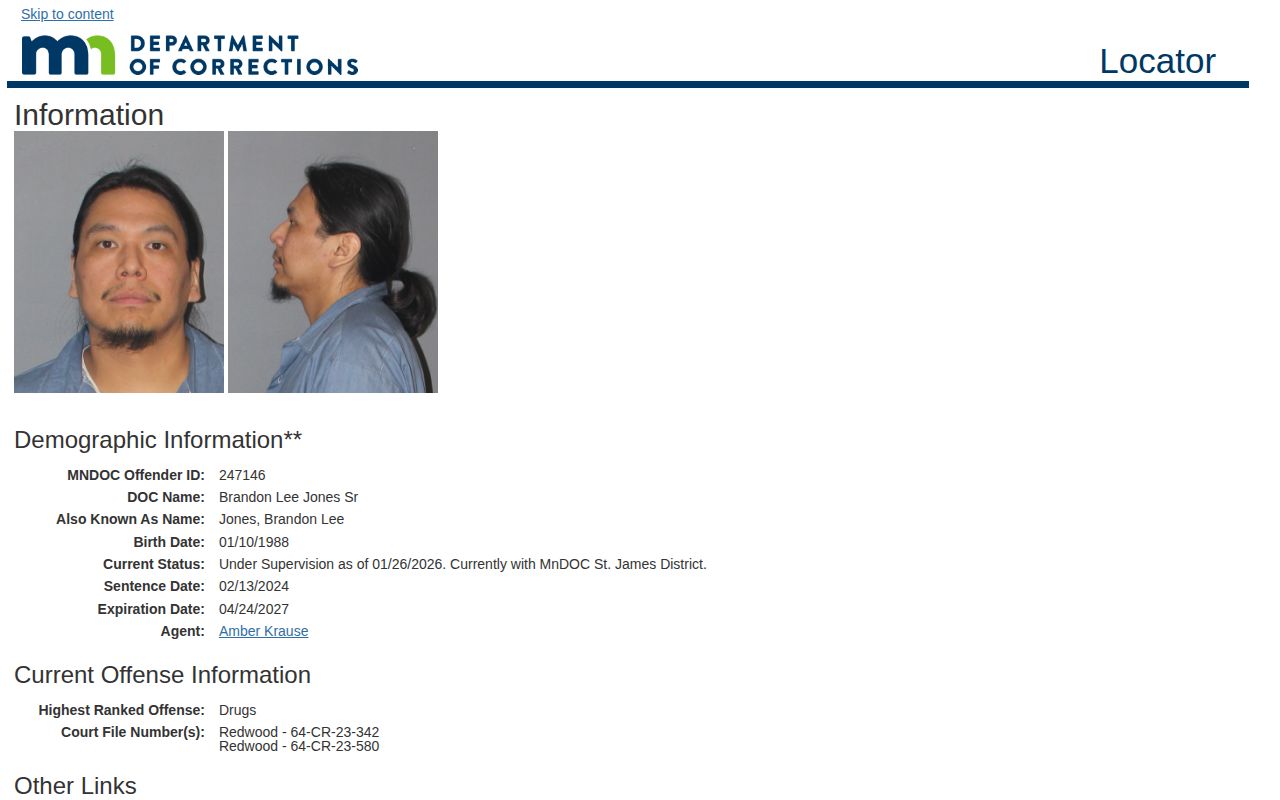
The example is a field-reading model. Verification still requires matching the named person and their own court or DOC identifiers.
- Search by first and last name, knowing that DOC uses prefix matching, or enter the complete six-digit MNDOC Offender ID.
- Open the correct result. Compare the DOC name, aliases, birth date, offense, and court file number rather than relying on a shared name.
- Read
Current Status. AnUnder Supervision as ofentry supports release from prison to supervision.Incarceratedmeans that prison release has not occurred. - Note the district, agent, status-effective date, and expiration date. Use the agent or official field-office route for an agency confirmation.
- If DOC has no fitting record, check the Grant County court case for probation, discharge, or revocation and identify the supervising entity named there.
A person can have more than one case or supervision term. Compare the case number whenever it is available. If the issue is whether someone left local custody rather than whether supervision exists, follow the full Grant County released-inmate search and records path. The Sheriff can identify a receiving jail, while a jail movement record supplies the physical release or transfer event.
Note: A no-result in the live DOC Locator can reflect final discharge, a jail-only case, spelling, timing, or a person outside DOC jurisdiction.
Grant County Supervision Office Route
Grant County adult felony field service is regional. The Minnesota DOC field-services directory places Grant County in the Moorhead District and routes it through the Morris office. A separate Grant, Stevens, and Pope community-services record corroborates that route. A Western Probation Services plan covers Big Stone, Grant, Stevens, Traverse, and Wilkin counties. That regional structure is why “the Grant County parole office” may lead to the wrong place.
Minnesota DOC Morris Office
Grant County service, Moorhead District
603 California Avenue
Morris, MN 56267
District supervisor listed: Dale Arnold
Verify the current office number through the directory or Minnesota DOC headquarters at 651-361-7200.
The directory prints (620) 589-7285. That area code appears inconsistent with a Minnesota office, so it is preserved here only as an apparent source anomaly, not presented as a reliable call number. Do not silently replace it with a guessed digit. The current Locator may show the actual agent and district for the named person, and DOC headquarters can confirm the live field-office contact.
Local probation may follow a different administrative route. Read the sentencing order and court entries before contacting an office. An officer may confirm only what law and agency policy allow, so the public DOC record and filed court order remain useful even when case-management detail cannot be discussed.
Grant County Parole Review Limits
Minnesota’s Supervised Release Board became effective in 2024. It is not a parole board for every ordinary determinate sentence. Its limited jurisdiction includes life sentences with a possibility of parole or supervised release, indeterminate sentences for crimes committed on or before April 30, 1980, and certain early-release reviews for people who were under 18 at the offense. Most ordinary post-1993 executed felony sentences follow Minnesota’s prison and supervised-release framework rather than waiting for a parole vote.
For an eligible Grant County case, use the Hearings and Release Unit calendar. The page carries the next public meeting, an updated review schedule, agendas, approved minutes, and recording links. Prior meeting materials stay on that page for about 90 days. No separate person-name decision database was found, so the sound sequence is to locate the review in the schedule or agenda, read approved minutes, then verify the person’s present status in the DOC Locator.
The board may assign a projected release date, continue a case with directives, deny release, set later review, rescind a prerelease grant after a violation, or grant final discharge where law allows. A board Parole Eligibility Date is the minimum term for an eligible person. It is not the same field as the Locator’s Anticipated Release Date.
Grant County Supervision Conditions
Conditions vary with the judgment, release authority, and person. At a high level, supervision can require contact with an officer, compliance with court or DOC directives, lawful conduct, and completion of case-specific obligations. The filed sentencing order, DOC release documents, and supervising officer are the sources for the actual terms. A general web description cannot establish what one person must do.
An alleged violation is also not the same as a final finding. It can lead to a report, a warrant, custody, a hearing, modification, or revocation, depending on the authority and facts. VINE may issue a custody-change alert if a participating agency receives the person, but it does not explain the complete supervision decision. Court entries or DOC records provide the more durable legal trail.
Keep the statuses separate. “Released to supervision” confirms a past prison-to-community change. “Wanted fugitive” concerns a later alleged evasion. Neither phrase alone gives the full case outcome.
Grant County Warrants and Fugitives
Grant County publishes a warrant landing page that links to a regional LETG/RMS list hosted on Stevens County infrastructure. This local arrangement can help determine whether a person released earlier is now wanted. It cannot show when the prior custody ended. If the regional interface is slow or unavailable, the county landing page and the Grant County Sheriff at 218-685-8280 remain the stable local starting points.
The Minnesota DOC active-fugitive search serves a different population. It covers people alleged to have violated community-release terms and to be evading DOC supervision. DOC lists a 24-hour tip line at 651-603-0026. The regional county warrant list and the state DOC fugitive tool must not be merged into a general list of released people.
A warrant concerns current wanted status. A DOC fugitive entry concerns alleged evasion while under correctional supervision. Neither is a custody roster, proof of a new arrest, nor proof of the date or reason for the person’s earlier release.
Note: Confirm urgent warrant information with the responsible agency because a live status may change after a web page is indexed or viewed.
Correct Grant County Supervision Data
A wrong status, identity, or release date should be raised first with the authority that created the record. Minnesota Statutes section 13.04 gives a data subject a route to inspect government data about themselves and challenge data believed to be inaccurate or incomplete. This is especially useful when a DOC supervision date, agency record, or identity field does not match an official court or correctional document.
Identify the precise field in dispute. Preserve the record as it appeared, state why it is inaccurate or incomplete, and attach support such as the relevant order or agency document. Follow the responsible authority’s challenge instructions. Starting with the original government record keeps the correction request tied to the custodian that can evaluate and amend it.
Grant County Supervision Discharge
Physical release and final discharge are separate events. A DOC record’s Under Supervision as of date supports the move from prison to community supervision. Its Expiration Date is the anticipated endpoint of DOC authority. The person remains under correctional jurisdiction between those points unless the record or a later lawful action shows otherwise.
Probation ends through the court and supervising system that control the case. A discharge order or Register of Actions entry may document completion, while a revocation can change the path. For board-eligible sentences, final discharge is available only where the governing law and board action permit it. Read the actual order or correctional record rather than assuming that the end of office reporting automatically ended the sentence.
Older or finally discharged people may disappear from the live DOC Locator because its stated scope is adults who remain under DOC jurisdiction. For historical confirmation, use DOC correctional records at co-records.doc@state.mn.us, the Grant County court case, or the office that maintained the supervision record. Those sources can distinguish a prison release date, a supervision start, and a final discharge.